
Can Republicans Survive the Tea Party and Trump?
In 1858 the man who would become the first Republican president famously asserted: “a house divided against itself cannot stand.” Abraham Lincoln was referring to the American nation’s precarious state of existing “half slave and half free” at the time, but his words are spookily relevant to his Party’s current predicament.
Following the Great Recession and the election of Barack Obama as the first African-American president in 2008, populist sentiment erupted across the country. Driven by a combination of economic instability and racial anxiety, grassroots movements on the political right gained traction, most notably under the banner of the Tea (‘Taxed Enough Already’) Party. These groups began to influence politics at local and state levels, distorting the Republican platform and electing individuals in primaries whose extreme views often prevented victory on a national stage. Party elites were faced with a conundrum: how to acknowledge the concerns of the disgruntled base without alienating the more moderate general election voters?
Failure to meet this challenge resulted in the inadequacy of Mitt Romney’s presidential campaign, the resignations of some key Republican establishment figures and the government shutdown in October 2013. The only thread keeping the Party intact appeared to be a shared hatred of Obama and his healthcare plan. It also benefitted the establishment that the Tea Party is a loose collection of groups with a common ideology rather than a centrally organised force.
In the wake of defeat in the 2012 election, the Republican Party re-grouped and published what commentators dubbed the ‘GOP Autopsy’, or the Growth and Opportunity Project. This 100-page document outlines past failures and proposes future steps required to ensure the Party evolves to appeal to modern America, with a particular emphasis on reaching out to minorities. After the turmoil of the previous four years, prospects were looking more positive. The Party was in recovery. They had a plan. And then along came Donald Trump.
Journalist for The Atlantic Molly Ball summarises: “with the rise of Trump, the old GOP civil war has ended. A whole new one has begun.” The businessman’s divisive language, unpredictable behaviour and controversial policies have exacerbated the rifts in the Party and created stubborn new ones. His securing of the nomination is disastrous for the healing process, with only 38% of registered Republican voters believing the party can unite behind Trump. Once again the Party has been plunged into a state of crisis, with the politics of anger threatening to tear apart the foundations of this already divided house.
A TEA PARTY HANGOVER?
Trump supporters and Tea-Partiers are not one and the same. While there are a number of overlaps, studies have revealed that in terms of demographics, Trump supporters are more likely to be without a college education whereas Tea Party followers are “less likely to be lower income” than the average American. Furthermore, while the Tea Party are very clear in their libertarian, small government ideology, Trump’s political vision is alarmingly vague.
What both groups share is a strong anti-establishment sentiment inflamed by feelings of anger and betrayal. Indeed, Trump’s vicious attacks on establishment darlings like Jeb Bush and rumoured willingness to run as an independent if the party did not select him as nominee, probably earned him support from the Tea Party camp. As Wall Street Journal columnist Gerald F. Seib explains, “his willingness to thumb his nose at the party in which he was running tapped into a clear Tea-Party impulse.”

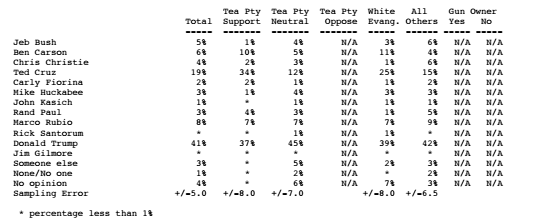
In order to ensure victory for his ‘movement’, Trump needs to court Tea Party voters, from whom he could learn a lot about changing the Party from within. Among the sizeable field of Republican candidates for the 2016 nomination, Trump had some tough competition in terms of individuals with links to the Tea Party. Rand Paul boasted a strong libertarian background and Ted Cruz was at one time the poster boy for the Tea Party, often acting as a representative for their views in the Senate. Despite these qualifications, a CNN survey of Republican voters and their candidate preferences (pictured below) revealed that among Tea Party loyalists, Trump was the favourite (37%), with Ted Cruz coming a close second (34%). This suggests that Trump and the Tea Party could form a tactical alliance with the ability to completely upend the Republican Party. With Tea Party backing Trump can solidify his popularity with the grassroots and create a formidable base of voters frustrated by the direction in which the party is going. From Trump, the Tea Party can gain ground at the one level it has failed to do so – the national stage.
A SYSTEM VULNERABLE TO POPULSIM
In contrast to Europe, where right-wing movements have been challenging the establishment through the formation of third parties, both Trump and the Tea Party are using the Republican Party as a vehicle to promote their agendas. Professor of transatlantic affairs, Dana Allin, explains: “in an entrenched two-party system like America’s, radicalism is more likely to take hold if it takes over one of the parties.”
Even though the Tea Party can hardly be said to have ‘taken over’ the Republican Party, the three-branch structure of the American system allows influence to be exerted even without infiltration of the party elite. The congressional gains made by Tea Party affiliates have pulled the party platform to the right on issues such as tax and immigration. The same individuals’ refusal to compromise on budgetary issues contributed to the government shutdown in 2013 and likely influenced the resignation of House Speaker John Boehner – one of the early signs that the establishment was losing its grip on the party.
Video 1
The Tea Party has been particularly successful at challenging the campaigns of establishment Republicans in local and state primaries, where voters tend to be more politically extreme and thus responsive to the organisation’s message. The aforementioned Growth and Opportunity Project includes a number of statements that suggest the Republican elite is all too aware of the Tea Party’s growing influence on candidates and party platform. The section on state parties includes the warning: “It would be a mistake for any one organization to think it can circumvent GOP voters and hand-pick our nominees. No one has a monopoly on knowing who is the best candidate; the electorate ultimately makes the decision.” These small insurgent victories are damaging for the Republicans because it wastes the money of loyal party donors and produces candidates who are unelectable at a national level.
What is remarkable about the Trump phenomenon is that a man with no political experience, who acts as a mouthpiece for those on the fringes, has catapulted to the top ranks of the party. The Republican establishment now has to contend with both a disgruntled base and a challenge from the very top. The chaos that Trump’s shock victory has caused was on full display at the Republican National Convention in July. Trump supporters clashed with both Ted Cruz (for his refusal to endorse the businessman) and delegates who were demanding a roll call vote in a last ditch attempt to prevent Trump gaining the nomination. The latter group included both conservatives (who feel Trump is not a true Republican) and moderates (who cannot abide his extreme views).
Video 2
THE RACE FACTOR
Donald Trump shares a history with the Tea Party through the so-called ‘birther movement’. This conspiracy theory, that questions Obama’s nationality and thus eligibility to be president, was promoted by the Tea Party and encouraged by Trump, who went as far as to demand a copy of the President’s long-form birth certificate. Such racially tinged animosity also spills over into immigration policy, on which both Trump and the Tea Party are hardliners.
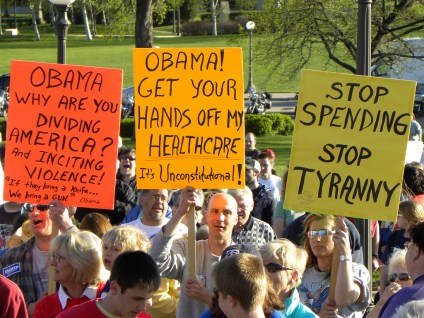
Reporting on the growing influence of extremists within the Party, journalist Joel Bleifuss confirms, “whoever wins the nomination, they will be a candidate who has traversed – and been tainted by – the xenophobic, white nationalist swamp that polite Georgetown Republicans had hoped to drain.” With his appeals to the so-called alt-right and support from white supremacists, it would seem that Trump has not just been tainted but practically baptised in these muddy waters.
In terms of the survival of the Republican Party, these radical pockets of influence are detrimental. The demographic make-up of America is increasingly diverse and an August 2016 Pew study revealed that millennials could soon be the majority voters in presidential elections. Republicans should be focussing on appealing to these potentially decisive groups. Then again, the short-term fallout of ignoring the vocal minority on the right could be disastrous.
THE RALLYING POWER OF NEW MEDIA
Where populist movements once struggled to get their voices heard, social media has provided a kind of modern soapbox for groups to air their views and recruit new followers. The reach of the internet means that geographical and time constraints are no longer an issue, thus the web makes for an indispensible rallying tool. Furthermore, it puts organisation and message-writing power firmly in the hands of ‘the people’, making it very hard for Party elites to control which issues ignite supporters.
Nowhere has this power been more apparent than in the impressive campaign of Bernie Sanders in the Democratic race. While his run for the nomination ultimately failed, he was successful in getting some of his policies onto the Democratic platform because he showed the establishment that a considerable section of the electorate agreed with him.
The problem for Republicans is that Trump won the nomination and so has the power to dictate future policy and promote his vision (which alienates and even embarrasses a significant portion of the Party). To add to this damage, Trump is still an avid user of social media. His Twitter feed, over which the establishment has no control, has been used to insult journalists and political rivals and re-tweet comments made by white supremacists. The ease and immediacy of social media combined with Trump’s impulsive and controversial behaviour has thrilling results for the restless base but creates a PR nightmare for the Republican Party.
RIP GOP?
We seem to have reached a point in America where rebuilding the political centre is impossible. The popularity of cable news channels and the proliferation of social media have created a culture of partisanship in which people are able to immerse themselves in an environment that reflects and reinforces their views, no matter how extreme. When groups like the Tea Party take advantage of this atmosphere, they have proven to have significant political sway. Political commentator David Frum explains: “something has changed in American politics since the Great Recession. The old slogans ring hollow. The insurgent candidates are less absurd, the orthodox candidates more vulnerable.”
Donald Trump appears to have picked up where the Tea Party left off, rallying the angry and disillusioned on the right and turning their zeal into a legitimate political movement, this time with the potential to go mainstream. The Republican establishment are now in a catch-22 situation. If they embrace Trump they risk losing the votes of staunch conservatives, independents and some moderates. Uniting behind Trump would also narrow the Party’s appeal to a shrinking base that is unlikely to be able to carry elections through the next decade.
However, ignoring the will of primary voters will only intensify the sense of neglect that fuelled this movement in the first place. What’s more, even if Trump loses the election the underlying problem remains. Republican pollster Frank Luntz goes as far as to warn: “if Trump loses, there will be a bloodbath.” The Republican Party was born in a political atmosphere of deep division and racial strife. It may die under similar circumstances.
Header Image by DonkeyHotey Via Flickr
Footage from Video 1 belongs to Face The Nation & C-Span
Footage from Video 2 belongs to CNN
Both produced and edited by AcrossThePond
 transatlantictalk.com
