
The sense of anticipation in the room swelled as committee members took to their seats and began shuffling papers expectantly. Journalists hustled for a prime spot. A few seconds later, the surprisingly small blonde woman entered the room and marched purposefully towards the witness chair. The camera lenses moved with her, hoping to catch a misstep or flicker of emotion on the typically controlled face. The woman is Hillary Clinton. This was October 2015 during the Benghazi hearings, but it could be mistaken for similar events spanning the last three decades – so long have her family’s various accomplishments and controversies dominated the American political scene.
Similar in its startling longevity is the polarising force of the Clinton name, particularly when it comes to Hillary. In a 1996 piece for The New Yorker entitled ‘Hating Hillary’, Henry Louis Gates outlined the then First Lady’s peculiar propensity for inspiring animosity: “Like horse-racing, Hillary-hating has become one of those national pastimes which unite the elite with the lumpen.”
As the Clinton matriarch campaigns for the highest office in the land, this vitriol shows no sign of disappearing. A Pew Research survey conducted in July revealed that among registered voters, a mere 18% considered Hillary to be ‘someone you admire’ and a dire 13% checked the box describing her as ‘honest’. While she has certainly been involved in an alarming number of scandals, she has emerged largely unscathed and boasts an incredibly successful career in an arena that is still dominated by men. In this election of extremes, even the prospect of President Donald Trump has done little to boost her favourability ratings. Just what is it about Hillary Clinton that makes her so unpopular?
CATEGORIES OF CLINTON
Having been a fixture of the political landscape for so many years, Hillary Clinton has inevitably filled a number of different roles. These range from the public (First Lady, Senator, Secretary of State, Presidential candidate) to the private (wife, mother, grandmother), though in this personality-obsessed world none is strictly one or the other. Indeed, Clinton treads a thin line trying to navigate these roles that require different approaches in terms of emotional vulnerability and professionalism.
The difficulty of this task is exacerbated by the fact that she is a woman attempting to excel in positions where success is often tied to characteristics stereotypically associated with men. She may be required to appear warm and maternal in her role as grandmother to appeal to people on a personal level, but then tough and composed to earn respect as Secretary of State. While such nuance is of course achievable it does not always translate well in media depictions of Hillary, where limitations on time and space can force journalists to try to compartmentalise even the most complex of figures. As a result, rather than making her appear a well-rounded person, changes in Clinton’s demeanour or attitude can spark accusations that she is disingenuous.
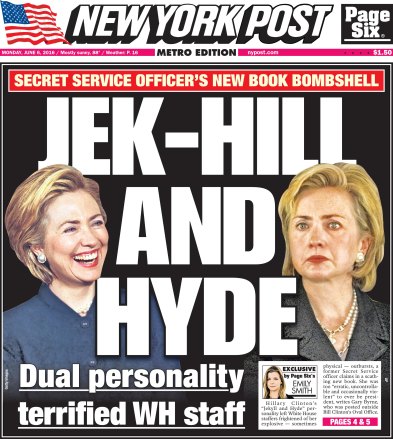
In a research paper examining coverage of the Benghazi hearings, Dustin Harp et al propose the existence of “a new bind that seems to be Clinton specific: one that pits competency in opposition to authenticity.” Clinton’s unique career poses the challenge of what we might call mastering the fluid female identity in a political context. She must adapt to a variety of positions whilst sustaining a personal likeability to ensure support from voters.
Most politicians must wrestle with perceptions of authenticity but female public figures are arguably dealing with an extra layer of scrutiny. Dr Jessica Ritchie of the University of Melbourne suggests that, for people who don’t trust Hillary, “what is most concerning (…) is not Clinton’s refusal to remain within the female gender category but her ability to oscillate between categories seemingly at will.” Ritchie goes as far as to suggest that instead of being an accomplishment, the ability to play multiple parts makes Hillary seem ‘cyborgian’ rather than successful.
HILLARY THE FEMINIST?
Over the course of her political career Clinton has both embraced and ignored her femininity. One of her early stand out moments was in 1995 at a UN conference in Beijing, where she famously asserted: “women’s rights are human rights.” However in her 2008 presidential campaign it was noticeable that Clinton avoided discussing her views on feminism, or ‘playing the woman card’, as Trump might say. This ultimately proved not to be a successful strategy.
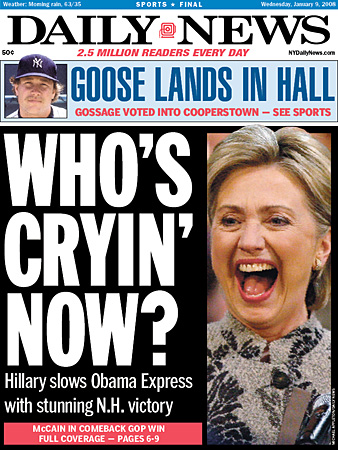
Interestingly, one of her unexpected victories in the 2008 primaries was in New Hampshire, which many commentators put down to the moment when Clinton, in an uncharacteristic show of vulnerability, appeared to get tearful while discussing the rigours of campaigning. The subsequent media coverage of this moment reveals the complex ways in which gender shapes evaluations of Clinton’s behaviour. The emotional moment was framed as bad for women as it fuelled sexist arguments that females are not strong enough to handle the daily grind of the campaign trail. Conversely, the incident was credited with motivating female voters, spurred on by sympathy, to ensure her victory in the state. Other outlets suggested that the moment was faked, a cynical political tactic to make Hillary appear more human. Professor Rebecca Curnalia of Kent State University summarises “within three days, Clinton was framed as a winner and loser, a broken-down ice queen and victorious strategist, someone who was unfeminine and yet could only appeal to women. She had set back feminism and inspired women.”
It is tempting when discussing the treatment of Hillary Clinton by the press to draw comparisons with depictions of other female politicians. Sarah Palin received her fair share of criticism and mockery. Margaret Thatcher embodied the Iron Lady characteristics that are now hastily attached to other women who emphasise their tough demeanour to excel on the political scene. With such a small pool to pick from, however, none of these examples are quite fitting. Each case is unique, with the individuals in question vying for different roles under completely different circumstances.
It remains uncertain whether Hillary’s gender is more of a help or hindrance to her political success. Clinton’s 2016 campaign is emphasising the historical significance of her nomination, evidenced in the choice of slogan: ‘I’m With Her’. Women now constitute the largest voting bloc in the USA and Hillary currently boasts a double-digit lead over Trump when it comes to female voters. Furthermore, people who aren’t inspired by her moderate liberalism may be able to rouse some excitement over the fact she would be the first female president.
The problem is that both approaches to the female issue (to promote or downplay) open this nominee up to a range of criticisms. Even in 2016, some media coverage makes one wonder if femininity and political success are mutually exclusive, but to ignore this inescapable truth further risks undermining Clinton’s authenticity.
MORALITY AND THE FEMALE POLITICIAN
To observe Hillary through the lens of women in American political history presents a contradiction that may explain her problems with likeability. Excluded from the realm of government for many decades, in the early 19th century, women “came to be regarded as the carrier[s] of civilization and, increasingly, as the custodian[s] of morals.” With strong ties to the church and activism for causes such as the temperance movement, women (at least those of a higher social status) were considered the moral core of the Republic – a vital counter force to the sleaze and corruption evident in male-dominated politics.
It is ironic then that arguably the most successful female politician in America today is plagued by controversy and accusations of immorality. From Whitewater to Travelgate, Benghazi to the personal email server, the Clintons constantly seem to be embroiled in one scandal or another. It is Hillary whose reputation seems unable to shake-off the damage these incidents have inflicted, as if she is expected to be of higher moral fibre than her predecessors (including her own husband) and thus has further to fall.
Henry Louis Gates’ account of her First Lady years includes the observation: “at times, it seems that Hillary Clinton has been labelled a saint in order that she may be found guilty.” Indeed, just this last year, attempts to hold her accountable for errors (both real and exaggerated) have been reminiscent of a witch trial. The Benghazi hearings, in which she was required to provide over 11 hours of testimony, quickly descended into a partisan-fuelled attack on her character. During the Republican National Convention the mention of her name would spark a disturbing level of hostility from the crowd, many of whom emphatically chanted ‘lock her up!’
Hillary on Trial: Chris Christie Addresses Crowd at RNC 2016
Adding unjust insult to injury, this current election season has seen her criticised for legislative decisions made by Bill Clinton’s administration and humiliated through repeated references to his infidelities. While she is certainly no saint (is there such a thing in the political world?) the cartoon villain version of Hillary used by the press, her political opponents and even fellow Democrats, overstates her flaws and is tinged with misogyny.
LEGACY
According to current polls, Hillary Clinton is set to become the next president of the United States. If she is to win, will she be able to carve out her own path, or will her legacy always be as one half of ‘the Clintons’? Neither route is likely to free her from the controversy and negative opinions that have plagued her career thus far.
Discussions of her suitability for the role often reference her intelligence, hard-working nature and the fact that she is qualified (even over-qualified), but that tends to be where the positives end. There is still a reluctance to commit to the idea that she is a wholly satisfying candidate.
Perhaps the tenacious ambition that is arguably vital to political gain, and that Hillary has certainly displayed, is not becoming of women. An American man I recently pressed on the matter eventually conceded: “I don’t think someone should run for president just because they think they deserve it.” This struck me as a peculiar reason to begrudge someone success. Disagree with her policies? Fine. Feel uneasy about the numerous scandals that have besmirched her name? Understandable. To imply that there is an audacity to her pursuance of the Oval Office says more about the constraints on female power than it does about Hillary’s personal journey to this historic moment. One would assume that every man who has filled that most coveted of roles felt deserving of it in order to summon the diligence required to achieve it.
Loathe her or love her, Hillary Clinton’s career is and could continue to be the benchmark for western women with political aspirations. With each new generation the name Lewinsky loses charge, discussions of Benghazi are increasingly limited to the halls of Fox News and email scandals seem both frequent and out-dated. If Hillary Clinton can get through the next four years on the merit of her achievements rather than the notoriety of her family name, she will be inspiring women across the world and shattering the densest of glass ceilings.
Maybe Americans should start looking for a new national pastime.
Header Image by Gage Skidmore via Flickr
Video belongs to Right Side Broadcasting
 transatlantictalk.com