
When citizens go to the polls on November 8th, their votes do not directly elect a candidate. Rather, they are voting for so-called electors from their state who have pledged allegiance to a particular candidate. It is the votes of these elected representatives from each state (known collectively as the Electoral College) that directly elect the President and Vice President.
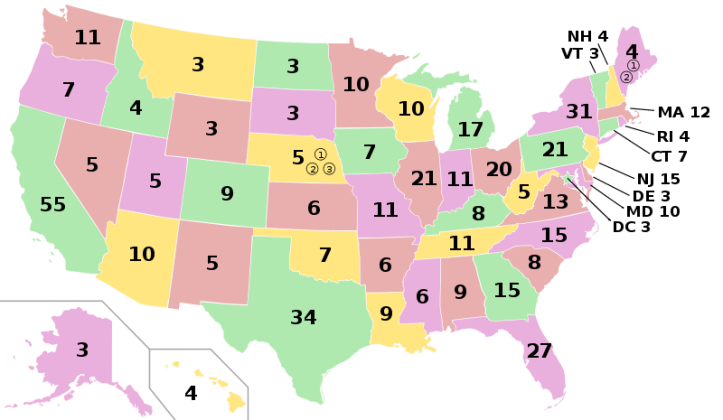
Map of Electoral College Votes Per State
The number of electors each state has is equal to its members of Congress, that is: individuals in the House of Representatives (based on state population) plus members of the Senate (each state is represented by two). In 1961 the 23rd Amendment provided the District of Columbia with three electors, equal to the number of electors awarded to the state with the smallest population. The Electoral College is currently made up of 538 electors. The state of California has the highest number of electors, with 55. In a presidential election, a majority of 270 Electoral College votes is required for a candidate to be declared the winner.
Who?
- Each political party usually nominates candidates to become electors.
- They tend to be individuals that have shown loyalty and/or service to a party.
- Anyone holding federal office is banned from becoming an elector.
Why?
Like many of the quirks of the American political system, the Electoral College was designed to be a compromise. The Founding Fathers were split over whether the president should be chosen by Congress or popular vote (albeit in that era by a very limited electorate). Under the Electoral College system, if the first stage (popular vote corresponding to electors) fails to produce a majority, it goes to a contingent election, in which each state delegation in the House of Representatives gets a single vote to elect the presidential candidate of their choice. Thus, the system allows mass participation by the electorate but ensures that the political establishment retains some control over the process.
How?
In elections free from complication, the electors are selected within each state, they then hold meetings after the popular vote has taken place and on January 6th Congress will count their votes and officially confirm the winner.
It is generally assumed that the electors of a state will uphold their pledges and vote according to the popular choice. However, electors are not legally bound to do so and while some states have implemented oaths and fines in order to ‘bind’ electors to their pledge, there have been a few cases of so-called faithless electors. Furthermore, as a result of this system not being completely democratic, there have been times when the winner of the popular vote did not gain the presidency (the most recent example being in the election of 2000).
The Electoral College system faces criticism on a number of grounds, including the fact that it causes candidates to focus on swing states, thus reducing the influence of other areas of the country. However, it also empowers smaller states and prevents an urban-centric approach to campaigning and politics in general.
 transatlantictalk.com